
Introduction
Reverse osmosis is an effective water purification technology. It removes dissolved salts, heavy metals, organics, and other contaminants with high efficiency — which is exactly why so many industrial facilities rely on it for process water, cooling water makeup, and wastewater polishing.
The problem is what RO leaves behind.
For every gallon of purified water an RO system produces, it also generates a concentrated reject stream — sometimes called brine or concentrate — that contains everything the membrane removed. This reject stream can represent 15 to 30 percent of the original feed water volume, and disposing of it is often far harder than treating the original source.
Evaporation is one of the most effective solutions for RO reject, particularly in facilities that need to minimize or eliminate liquid waste discharge entirely.
What Is RO Reject?
Reverse osmosis reject — also called RO concentrate or brine — is the high-TDS (total dissolved solids) stream produced when an RO membrane separates purified permeate from the dissolved solids in the feed water.
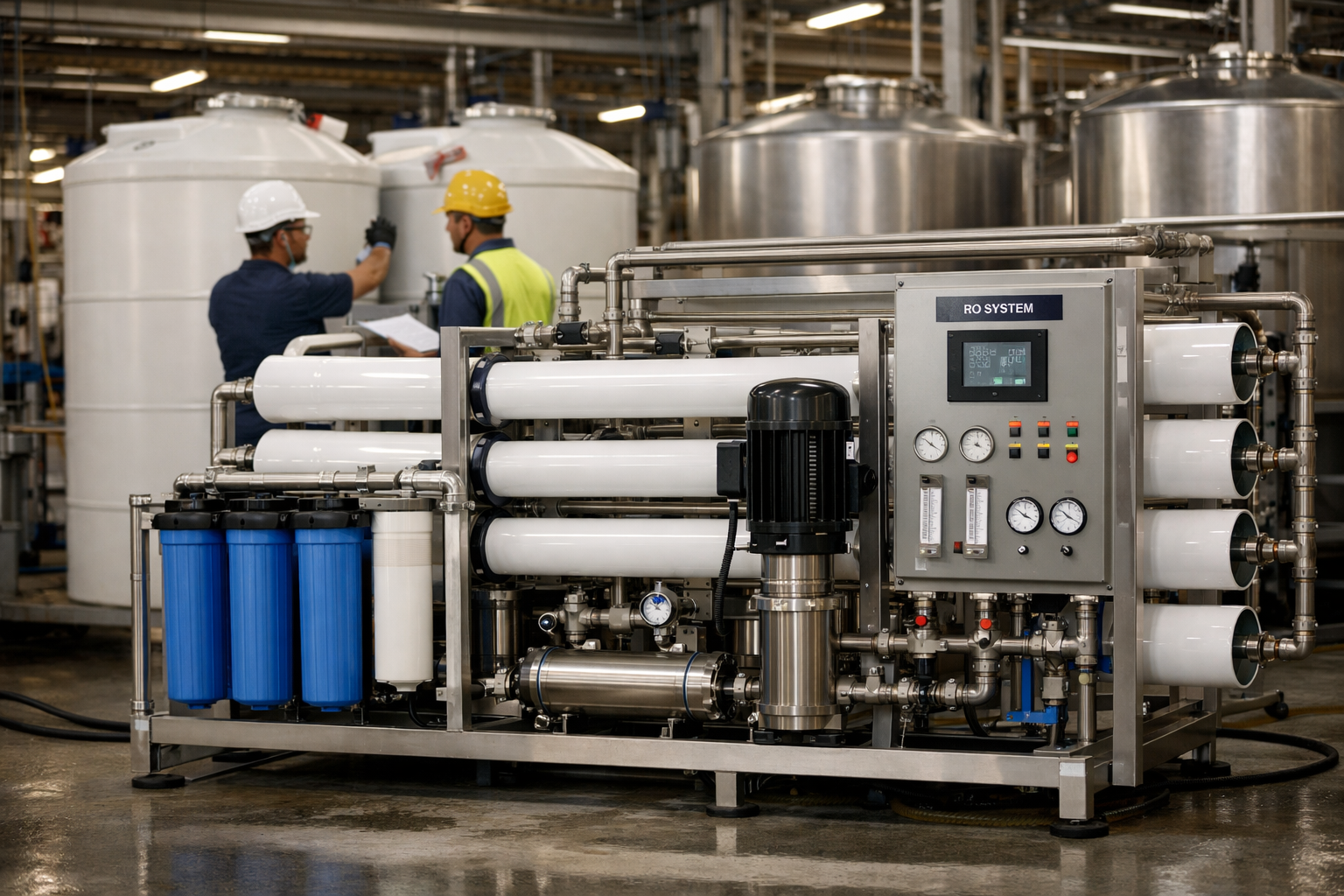
In a typical industrial RO system, feed water enters under pressure. Clean water permeates through the membrane and is collected for use. The remaining fraction, now concentrated with the dissolved solids that couldn’t pass through, exits as reject. The higher the recovery rate of the RO system, the more concentrated the reject becomes.
For facilities treating municipal water or relatively clean process water, TDS in the reject stream might be a few thousand milligrams per liter. For systems treating industrial wastewater or high-TDS feed sources, reject concentrations can be much higher — sometimes tens of thousands of mg/L. At those concentrations, sewer discharge is typically not an option, and the volume can still be significant enough to make hauling expensive.
Why RO Reject Is Difficult to Manage
The challenge with RO reject isn’t that it’s unusual — it’s that it sits in an awkward middle ground. It’s not clean enough to discharge. It’s not concentrated enough to be cheap to haul. And it’s being generated continuously, so it accumulates.
Several factors complicate disposal:
Sewer limits. Most municipal pretreatment programs set limits on TDS, conductivity, or specific ions. High-TDS RO reject frequently exceeds these thresholds, blocking the most convenient disposal pathway.
Volume. Even in a modest operation, a facility running a 50 GPM RO system at 75% recovery is generating more than 12 GPM of reject. That’s over 17,000 gallons per day — a significant hauling burden if no on-site solution exists.
Variable composition. RO reject reflects whatever was in the feed water, concentrated. For facilities treating complex industrial streams, that can mean heavy metals, nitrates, chlorides, or a mix of contaminants that complicates downstream treatment options.
MLD & ZLD requirements. Industries under pressure to achieve Minimal Liquid Discharge (MLD) or Zero Liquid Discharge(ZLD) — pharmaceutical, semiconductor, specialty chemical — need a way to handle RO reject without any discharge to drain or sewer. That typically means evaporation.
How Evaporation Handles RO Reject
An evaporator solves the RO reject problem by removing the water that makes it bulky and expensive, concentrating the dissolved solids into a much smaller volume or a dry solid.
The process is well-matched to RO reject for several reasons:
RO reject is already partially concentrated. The RO system has done the first stage of concentration. An evaporator picks up where the membrane left off, pushing the reject to much higher concentration levels or to dryness. This reduces the total energy input required compared to evaporating raw wastewater.
The water in RO reject is recoverable. Because RO reject is a relatively clean stream from a suspended-solids perspective (the membrane rejects particulates), the condensate from an evaporator can often be recovered as high-quality distillate if desired. This closes the water loop — the purified condensate can be returned to the RO feed, used as process water, or discharged, depending on quality.
The concentrated residue is manageable. After evaporation, what remains is a concentrated slurry or, with further processing through a slurry dryer, a dry solid. Either form is dramatically cheaper to dispose of than liquid reject, and in some cases the concentrated salts have recovery or recycling value.
Applications: Where RO + Evaporation Makes Sense
This combination shows up across a range of industries, typically wherever RO is used as part of a water treatment or wastewater treatment system.
Pharmaceutical manufacturing uses RO extensively for purified water production. Reject streams must meet strict waste management requirements, and MLD & ZLD is increasingly the expected standard in many regions and facilities.
Semiconductor and electronics fabrication generates ultra-pure water for rinsing, and the reject from those systems can contain trace metals and proprietary chemistry that cannot be discharged untreated.
Food and beverage processing uses RO for water treatment and concentration processes. Reject is typically lower in hazardous contaminants but can be high in TDS and BOD, creating discharge challenges.
Power generation facilities use RO for boiler makeup water. Reject is often high in hardness and dissolved minerals and is generated in large volumes.
Landfill and industrial wastewater treatment — RO is increasingly used as a polishing step in complex treatment trains. The reject from these applications tends to be particularly challenging, with high TDS and variable organic loading.
In each case, the evaporator allows the facility to manage the reject on-site without ongoing reliance on discharge permits or hauling contracts.
Pairing the Right Evaporator with Your RO System
The best evaporator for RO reject depends on the volume of reject you’re generating, its composition, and whether you need full ZLD or just significant volume reduction.
Thermal evaporators are a reliable, economical choice for facilities with steady reject volumes and straightforward chemistry. They handle a wide TDS range and are available in capacities from a few gallons per hour to thousands of gallons per day.
Vacuum Heat Pump (VHP) and Mechanical Vapor Recompression (MVR) evaporators are worth evaluating when energy efficiency is a priority. These systems can achieve the same volume reduction as other evaporation technologies with substantially less energy input — which matters when handle large volumes of reject.
For facilities that need to eliminate all liquid waste entirely, a thermal evaporator or VHP unit paired with a slurry dryer completes the ZLD train. The evaporator concentrates the reject; the dryer finishes it to a dry solid.
If you’re not sure what volume of reject your system is producing or what concentration levels you’re dealing with, ENCON’s engineering team can help you work through the numbers and identify the right fit. Contact us to talk through your RO reject situation.
Conclusion
RO reject is an unavoidable byproduct of reverse osmosis — and for many facilities, it’s become the hardest part of an otherwise effective water treatment system to manage. The combination of high TDS, significant volume, and limited discharge options makes it a natural target for on-site evaporation.
Used together, RO and evaporation form a powerful water management system: the membrane does the first stage of purification and concentration, and the evaporator handles everything the membrane can’t discharge. The result is a closed loop that reduces operating costs, eliminates discharge risk, and in many cases produces recoverable clean water as a byproduct.

.png?width=352&name=Worker%20Sampling%20Blowdown%20(1).png)