
How Does Wastewater Evaporation Work?
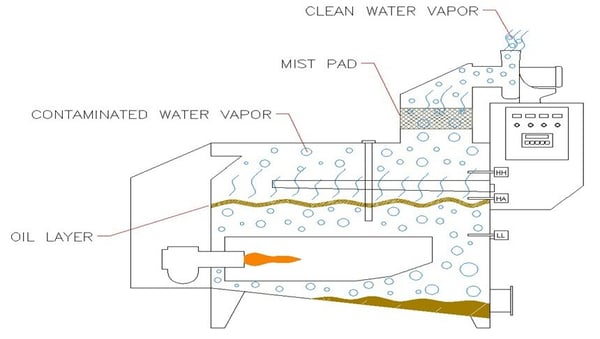
Evaporation involves two simultaneous phenomena: thermodynamic and mass transfer. Together, they drive the separation of water from the waste stream.
Thermodynamic phase: Heat energy - from natural gas, propane, electricity, steam, waste oil, or waste heat — is applied to the waste stream until enough energy is absorbed to convert liquid water into water vapor. The evaporator's design manages this transition efficiently.
Mass transfer phase: At the surface of vigorously boiling water, tiny water droplets become airborne and are carried off by high-capacity blowers. In ENCON systems, a mist pad technology (first introduced in 1993) captures any fine droplets before discharge, ensuring clean emissions and regulatory compliance.
The result is a clean water vapor stream released to atmosphere and a concentrated liquid or solid residue that is a fraction of the original waste volume - typically 99% smaller by volume.
What Happens to the Wastewater During Evaporation?
As the water evaporates, the contaminants dissolved or suspended in the waste stream become increasingly concentrated in the remaining liquid. ENCON evaporators are designed to carry this process through to the optimal endpoint for each application:
- For most industrial users, the evaporator runs until a manageable concentrate is produced - still a pumpable liquid waste product, but reduced 90% to 99% in volume.
- For facilities targeting Zero Liquid Discharge (ZLD), ENCON's Slurry Dryer can carry the process further, producing a dry, solid residue with virtually no remaining liquid waste.
- The concentrated residue is then containerized and disposed of by a licensed hauler, typically at a fraction of the original disposal cost.
Is Evaporation a Physical or Chemical Process?
Evaporation is a purely physical separation process. This is a significant advantage over chemical precipitation and other treatment methods that require chemical inputs, often generate low consistency waste sludge, and demand careful operator oversight. Evaporation simply uses energy to separate water from contaminants - the waste stream's chemistry is concentrated, not altered.
What Kinds of Waste Streams Can Be Evaporated?
Evaporation technology is exceptionally versatile and can handle a much broader range of waste streams than membrane systems or chemical treatment. ENCON evaporators have successfully processed:
- Metal finishing and plating rinse water
- Metal machining
- Compressor condensate
- Landfill leachate
- Reverse osmosis (RO) reject / concentrate
- Ion exchange resin regenerate
- Parts washing and degreaser waste
- Food and beverage process water
- Pharmaceutical process effluent
- Chemical process waste streams
- Cleaning and mop water
If a waste stream is substantially water - typically 70% to 99% water by volume - it is likely an excellent candidate for evaporation. ENCON's free waste stream analysis confirms suitability before any capital commitment.