When Should You Rent vs. Buy an Industrial Evaporator?
For most industrial facilities, the question of whether to rent or buy equipment comes down to three things: how long you'll need it, how certain that need is, and how much capital you can commit. Industrial evaporators are no different — but wastewater treatment adds a layer of urgency that other equipment decisions don't always carry. A broken-down conveyor is a production problem. An untreated wastewater stream can be a compliance violation.
This guide walks through the key scenarios where renting makes more sense than buying — and where buying is clearly the better long-term investment.
What Is an Industrial Evaporator Rental?
Industrial evaporator rental is a short- to medium-term arrangement in which a manufacturer provides a fully operational evaporator unit — typically pre-configured and ready to deploy — on a lease or rental basis, allowing facilities to treat wastewater without a capital equipment purchase.
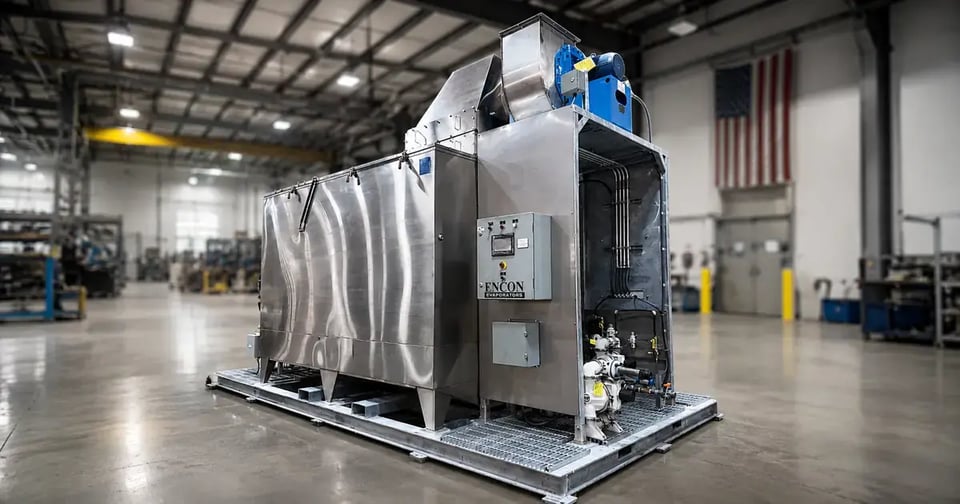
Rental units are typically the same equipment as purchased units, not stripped-down alternatives. At ENCON, for example, rental evaporators are the same thermal, drum and vacuum heat pump models used in permanent installations. They arrive configured for the waste stream, with support available from the manufacturer during the rental period.
Reasons to Rent an Industrial Evaporator
You Need to Pilot Before You Commit
If your facility is generating a new or unusual waste stream — spent coolant from a newly installed CNC process, pharmaceutical rinse water, or a high-TDS concentrate from a reverse osmosis system — you may not yet know the exact evaporation behavior of that waste. Pilot testing on a rental unit lets you validate performance, measure evaporation rates, and refine your operating parameters before specifying a permanent system.
This is especially valuable when the waste stream chemistry is complex or variable. Discovering that your coolant foams under heat, or that your concentrate builds scale faster than expected, is far less costly to handle during a pilot than after commissioning a $100,000 permanent system.
You Have a Temporary Volume Spike
Some facilities generate wastewater unevenly — a construction project, a seasonal production run, a one-time equipment cleaning campaign, or a major customer ramp-up. If that elevated volume will last six months and then taper off, buying a unit sized for peak capacity means owning oversized equipment for years.
Renting bridges the gap. You get the throughput you need during the spike without tying up capital in a unit you'll underutilize later.
You're Facing a Compliance Deadline
Regulatory pressure doesn't always come with a lead time long enough to engineer and install a permanent solution. If your facility has received a notice of violation, is preparing for an inspection, or needs to demonstrate compliance with a new pretreatment standard while a permanent system is being specified and procured, a rental unit can be operational in days rather than months.
This is one of the most common reasons facilities call ENCON for a rental: they need something working now, and a permanent system will follow once the immediate pressure is resolved.
Your Long-Term Wastewater Needs Are Uncertain
Facilities undergoing process changes, ownership transitions, plant expansions, or regulatory reviews may not know what their wastewater picture will look like in two years. Committing to permanent capital equipment under that level of uncertainty is a real risk. Renting preserves optionality — you can treat your waste stream reliably today and make the buy decision once the future is clearer.
Reasons to Buy an Industrial Evaporator
You Have a Known, Ongoing Waste Stream
If your facility generates wastewater continuously — spent metalworking fluids every week, plating rinse water year-round, compressor condensate from a permanent compressed air system — the economics of ownership almost always outperform renting over a two- to five-year horizon. The monthly rental cost that made sense for a six-month pilot becomes a significant line item if it runs indefinitely.
Purchasing also lets you specify the unit precisely for your stream: capacity, materials of construction, heat source, and optional add-ons like slurry dryers for ZLD applications. A permanent installation is optimized for your facility; a rental unit is configured to be versatile.
Your Hauling Costs Are Substantial and Ongoing
If you're currently spending $2,000 to $5,000 per month — or more — on wastewater hauling, you're already funding the purchase of an evaporator every few years without getting the asset. Many facilities that do a basic cost analysis find that a purchased evaporator pays for itself within 18 to 36 months of eliminating or dramatically reducing hauling costs.
That breakeven math is straightforward: take your current annual hauling spend, compare it to the installed cost of a system sized for your volume, and factor in operating costs (energy, maintenance). For many manufacturing facilities, the numbers are compelling. Learn how evaporators reduce hauling costs.
You Need a Customized System for a Difficult Stream
Some waste streams require more than a standard configuration. Landfill leachate, pharmaceutical process water, and high-chloride streams may need specific materials, corrosion-resistant construction, or multi-stage evaporation to reach the discharge or reuse specifications you're targeting. That level of engineering customization isn't available in a rental unit — it's built into a permanent, site-specific system designed around your actual chemistry.
A Framework for the Rent-vs.-Buy Decision
If you're unsure which path fits your situation, these questions help clarify it:
- How long will you need the evaporator? Less than 12 months — rent. More than 24 months — buy. Between 12 and 24 months, run the cost comparison.
- How certain are you of the volume and stream chemistry? High uncertainty — rent first, pilot, then buy. High certainty — buy and optimize.
- What's your capital situation? If capital is constrained and the ROI timeline is long, rental preserves cash flow. If the evaporator pays back in under three years, purchasing is almost always preferable.
- Do you have a compliance deadline? If yes, rent to get operational quickly, then evaluate permanent installation on a parallel track.
- Is this a pilot for a larger or multi-unit installation? Rental is the right first step whenever you're evaluating evaporation for a new application or want to demonstrate performance to management before a larger capital commitment.
ENCON's Rental Program
ENCON offers rental units for facilities that need proven wastewater evaporation capability without a long lead time. Rental units are the same equipment used in permanent installations — thermal, drum and vacuum heat pump (VHP) models — and are supported by the same engineering team that designs permanent systems.
Whether you need a unit for a compliance emergency, a pilot program, a temporary volume spike, or a bridge while a permanent system is being installed, ENCON can typically deploy a rental unit faster than any other path to treatment. Explore ENCON's rental options, or contact the ENCON team to discuss your facility's situation and get a recommendation.
The right answer — rent or buy — depends on your specific timeline, volume, and circumstances. ENCON can help you think through the numbers and make the decision that serves your facility best.