Floor Scrubber & Mop Wastewater Treatment
- Home
- »
- Applications
- »
- Floor Scrubber & Mop Water Wastewater Treatment
Floor Cleaning Wastewater
Your floor cleaning program generates a regulated waste stream — oily, chemical-laden, and increasingly scrutinized by sewer authorities. ENCON evaporators eliminate the liquid, shrink disposal volume by up to 99%, and keep you permanently in compliance.
What Is Floor Scrubber & Mop Water Wastewater?
Industrial facilities and commercial buildings rely on powered floor scrubbers and manual mopping to maintain safe, clean work environments. These machines pick up everything they contact — machine oils, hydraulic fluid, coolant residue, cleaning chemicals, heavy metal particles from machining operations, suspended solids, and biological matter.
The result is a surprisingly complex wastewater stream. A factory floor scrubber doesn't just collect dirt: it collects a concentrated mixture of contaminants that have accumulated since the last cleaning cycle.
Where Does It Come From?
Manufacturing Floors
Machining, metalworking, fabrication — picks up coolants and metal fines.
Warehouses & Distribution
Forklift fluid drips, pallet residue, and cleaning carryover.
Auto Service & Fleet
Engine oil, transmission fluid, and high hydrocarbon loads.
Surface Finishing
Chrome, nickel, and zinc particles (40 CFR Part 433).
Typical Contamination Profile
Is Floor Scrubber Water a Regulated Waste?
Yes — and many facilities don't realize it. For decades, maintenance workers have emptied floor scrubber tanks into the nearest floor drain, treating the water as ordinary housekeeping waste. Regulators and sewer authorities disagree.
In production and process areas, floor and mop water is regulated under EPA Metal Finishing pretreatment standards (40 CFR Part 433). This applies to facilities involved in electroplating, metal polishing, printed circuit board manufacturing, and related operations.
In all other areas (warehouses, offices, food production), the water is subject to local sewer authority pretreatment limits — most critically for oil and grease, where typical discharge limits of 50–200 mg/L are routinely exceeded by scrubber water containing oil and grease in the thousands of mg/L.
Discharging to a storm drain is illegal and environmentally harmful, carrying potential fines and enforcement action under the Clean Water Act.
Metal Finishing Pretreatment
Applies to scrubber/mop water from production areas. Regulates metals, cyanide, and other parameters to strict limits.
Oil & Grease: 50–200 mg/L
Scrubber water typically exceeds these limits by 10–50x. Sewer discharge requires verified compliance.
No Storm Drain Discharge
Dumping scrubber water into storm drains is illegal and subject to fines. Storm drains lead directly to waterways with no treatment.
Eliminates Liquid Discharge
Evaporation converts liquid waste to a concentrated solid or semi-solid, removing the need for sewer discharge compliance entirely.
Floor Scrubber Water: Regulation Is Real — and Often Overlooked
Oil & grease in scrubber water can be 10 to 50 times above sewer limits. Most facilities generating this waste are non-compliant without knowing it. Evaporation eliminates the problem permanently.
How Is Floor Scrubber Wastewater Typically Disposed Of?
Facilities managing this waste stream have historically relied on a handful of approaches, each with meaningful limitations. Understanding the tradeoffs is essential to choosing the right long-term solution.
| Disposal Method | How It Works | Compliant? | Ongoing Cost | Key Problems |
|---|---|---|---|---|
| Floor Drain / Sewer Discharge | Direct disposal to sanitary sewer via floor drain or mop sink | ✗ Rarely | Low (no direct cost) | Almost always exceeds local O&G limits; regulatory violation risk; potential fines and enforcement action |
| Pretreatment + Sewer | Chemical coagulation, oil skimming, and/or filtration before sewer discharge | ~ Conditionally | Moderate | Complex chemistry; ongoing compliance monitoring; chemical costs; sludge management; still generates a waste stream |
| Wastewater Hauling | Collect in tanks or drums; third-party hauler transports for off-site disposal | ✓ Yes | High & escalating | Hauling fees increase 5–15% annually; scheduling disruptions; driver liability; manifest burden; sustainability concerns |
| Oil/Water Separator | Gravity or coalescing separator removes free oil before discharge | ~ Partial | Moderate | Removes only free oil — emulsified oils pass through; does not address metals, detergents, or dissolved solids |
| ★ Wastewater Evaporation (ENCON) | Heat drives off water vapor; contaminants concentrate into a small solid/semi-solid residue | ✓ Yes | Moderate | Initial capital investment required; not all streams are suitable — ENCON lab analysis confirms suitability at no charge before commitment |
The Real Cost of the Status Quo
Hauling Costs Keep Climbing
Industrial waste hauling rates increase 5–15% annually. What costs $200/pickup today could double within a decade. Volume fluctuates, making budgeting difficult and operational planning unpredictable.
Compliance Risk Is Real
Inspectors and pretreatment coordinators are actively increasing scrutiny of industrial floor cleaning waste. A single violation notice can trigger costly sampling programs, legal fees, and remediation obligations.
Pretreatment Is Complex
Chemical coagulation systems require trained operators, reagent purchasing, regular jar testing, and sludge management. They trade one disposal problem for several others — and still leave you exposed to sewer limits.
Oil/Water Separators Don't Solve the Problem
Cleaning agents and surfactants emulsify oils, preventing effective gravity separation. Emulsified oil, dissolved metals, and detergent residues pass through separators into the sewer untreated.
How Does Wastewater Evaporation Work for Floor Scrubber Water?
Evaporation is the most direct answer to the disposal problem: if there's no liquid, there's nothing to discharge or haul. ENCON evaporators apply controlled heat to your floor scrubber water, driving off water as clean vapor. What remains is a concentrated residue — a fraction of the original volume — that is far easier and less expensive to dispose of than hundreds of gallons of liquid.
For most floor scrubber streams, evaporation reduces liquid volume by 95–99%. A 55-gallon drum of waste becomes a small pail of residue. Annual hauling costs that once ran thousands of dollars shrink to almost nothing.
Before & After Evaporation
Evaporator
residue
ENCON Evaporators for Floor Scrubber Wastewater
Two ENCON evaporator families are well-matched to floor scrubber and mop water streams: the simple, low-cost Drum Evaporator for smaller volumes, and the high-capacity Thermal Evaporator for facilities with larger or continuous flows.
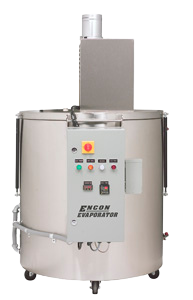
ENCON Drum
Evaporator
Economical, compact, easy to operate. Drop-in solution for facilities generating up to 55 gallons per batch. No plumbing required.
- Processes a standard 55-gallon drum in place — no tank required
- Ideal for low to moderate scrubber volumes
- No plumbing or infrastructure modifications needed
- Natural gas, propane, or electric heat source options
- Minimal operator attention required
- Lowest capital cost — often fastest ROI against hauling
- Easy to relocate within facility
ENCON Thermal
Evaporator
Industrial-grade, continuous-duty evaporator for facilities with significant scrubber volumes or multiple machines. Automates the process end-to-end.
- Handles higher volumes from multiple scrubbers or facilities
- Continuous-duty operation — runs unattended
- Widest selection of heat source options in the industry
- Automation options: auto-fill, auto-dump, level controls
- Optional condenser for clean distillate recovery and reuse
- Air permitting and permit-exemption services available
- 2,000+ installations worldwide; trusted by 3M, GM, Ford, Caterpillar
Why Evaporation Is Particularly Well-Suited to Floor Scrubber Water
Floor scrubber water is typically 95%+ water, making evaporation highly efficient with minimal energy input per gallon processed.
Oils, metals, and solids don’t evaporate — they stay behind and concentrate while clean vapor is released. The separation is natural and efficient.
Regular floor cleaning generates predictable volumes — easy to size an evaporator that processes waste as fast as it’s generated.
Facilities hauling floor scrubber water can see payback in as soon as 12 months when switching to an ENCON evaporator.
Floor Scrubber Wastewater: Common Questions
What contaminants are typically found in floor scrubber water?
Floor scrubber and mop water from industrial environments typically contains: oil and grease (often in the 500–5,000+ mg/L range), total suspended solids from dirt, metal fines, and debris, detergents and surfactants from cleaning agents, and — depending on the facility — heavy metals such as zinc, copper, nickel, and chromium picked up from machining or surface finishing operations. pH can range widely from alkaline (cleaning chemicals) to neutral or mildly acidic.
The specific composition depends heavily on industry and operations. A metal fabrication shop generates very different scrubber water than a food processing plant or warehouse. ENCON's lab analysis characterizes your specific stream before recommending a solution.
Can floor scrubber water be discharged to the sewer?
In most cases, untreated floor scrubber water cannot be legally discharged to the sanitary sewer. Oil and grease concentrations alone typically exceed local pretreatment limits by an order of magnitude or more. In production and process areas at metal finishing facilities, it is explicitly regulated under 40 CFR Part 433. Even in non-manufacturing areas, the oil and grease content is almost always above the 50–200 mg/L limits that most sewer authorities enforce.
Discharging to a storm drain is illegal under the Clean Water Act and carries potential fines and enforcement action. The safest compliance path is pretreatment before sewer discharge, hauling, or evaporation — which eliminates the liquid discharge problem entirely.
What happens to the oil and solids in the evaporator?
During evaporation, water vapor rises and exits the evaporator as steam through a vent (or optionally through a condenser to recover clean water). Oils, solids, metals, and other non-volatile contaminants remain behind in the evaporator vessel and concentrate as the water volume decreases. When the cycle is complete, a small volume of concentrated residue — a fraction of the original liquid volume — is removed for disposal. This residue is dramatically less expensive to haul than hundreds of gallons of liquid waste.
Do I need to pretreat the water before loading it into an ENCON evaporator?
In most cases, no. One of the advantages of evaporation is that extensive pretreatment is generally not required. However, very high oil concentrations can affect evaporator performance and may benefit from oil skimming before loading, and certain chemical compositions can affect materials of construction selection or require pH adjustment. ENCON's free bench-scale analysis determines exactly what, if any, conditioning is needed before evaporation proceeds.
Which ENCON evaporator is right for my floor scrubber volume?
For most small-to-medium facilities generating 55 gallons or less per day or per cleaning cycle, the ENCON Drum Evaporator offers the lowest cost and simplest operation — it processes a standard drum in place with no plumbing required. For larger facilities with multiple scrubbers, higher daily volumes, or continuous generation, the ENCON Thermal Evaporator scales up to handle hundreds of gallons per day with automation and minimal operator intervention. Your ENCON Sales Engineer will recommend the right fit after reviewing your volume and waste stream characteristics.
Is there a permit required to operate a wastewater evaporator?
Requirements vary by state and municipality. Many ENCON installations qualify for permit exemptions, particularly at smaller operating scales. ENCON offers air permitting and permit-exemption services to help navigate this process — it is a routine part of our project support. Your Sales Engineer will address this during the qualification process.
How Do I Determine If My Wastewater Is Appropriate for Evaporation?
The centerpiece of our consultative approach is the wastewater qualification process. Not all waste streams are good candidates for evaporation. We believe it's better to find that out in our laboratory than on your factory floor.
This free analysis determines how appropriate the waste stream is for evaporation and how it will function in the ENCON evaporator. This analysis also helps determine materials of construction and allows us to determine operating procedure recommendations. If more detailed analysis of specific parameters is needed, ENCON can prepare appropriate samples and send them for outside lab analysis for a nominal cost (prices for analytical tests vary).
Once the analysis is complete, your ENCON Sales Engineer will deliver a report detailing the results to you. This report includes material of construction and pH adjustment recommendations, if needed. This allows you to make an informed decision if an ENCON evaporator is right for you.
Related Applications & Resources
Stop Paying to Haul Floor Scrubber Water
Talk to an ENCON Sales Engineer. Get a free waste stream analysis and a clear-eyed assessment of whether evaporation is the right fit for your facility.