What Are the Signs That Evaporation Is Right for Your Facility?
Evaporation is not the right fit for every situation, but for many facilities it is often the simplest, most cost-effective, and most flexible long-term solution. Here are the six clearest signals that it's worth evaluating:
1. Your Hauling or Disposal Costs Are Rising
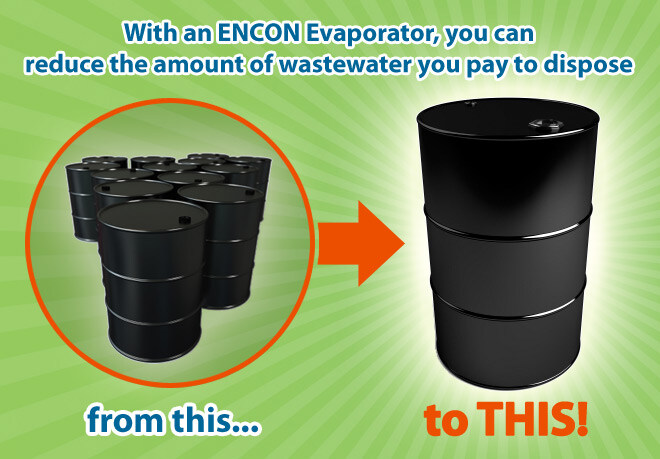
If you are paying to have liquid wastewater picked up and disposed of off-site, every gallon of water you are hauling is a direct and unnecessary cost. Evaporating that water on-site eliminates it from your disposal manifest. Facilities that switch to evaporation routinely reduce their liquid disposal volume by 95% to 99%, with proportional reductions in hauling costs.
2. You Are Struggling to Meet Sewer Discharge Limits
If your local publicly owned treatment works (POTW) is tightening its discharge limits - or your effluent quality can no longer consistently meet permit requirements - evaporation removes the discharge obligation entirely. There is nothing to monitor, no discharge permit to maintain, and no risk of a sewer compliance violation.
3. Your Current Treatment System Is Too Labor-Intensive
Chemical precipitation, filtration, and membrane systems all require significant operator time: dosing chemicals, monitoring effluent quality, managing membrane integrity, and disposing of chemical sludge. Evaporation is inherently more hands-off. Once set up and running, most ENCON systems require only periodic checks and concentrate disposal - dramatically reducing day-to-day labor burden.
4. Your Waste Stream Chemistry Is Changing or Unpredictable
Many wastewater treatment technologies are sensitive to variation in feed stream pH, ionic strength, or contaminant composition. Membranes foul. Chemical precipitation reagent ratios shift. Evaporation is inherently tolerant of waste stream variability. As long as the stream is predominantly water, an ENCON evaporator can handle it - even as your manufacturing process evolves.
5. You Are Planning a Process Expansion
If your manufacturing output is expected to grow, your wastewater volume will grow with it. Evaporation scales more gracefully than many alternatives. ENCON systems can be sized for future capacity from the outset, and additional units can be added as volume increases - without the re-permitting complexity that often comes with expanded discharge volumes.
6. You Want to Move Toward Zero Liquid Discharge (ZLD)
Growing regulatory pressure, corporate sustainability commitments, and water stewardship goals are driving more industrial facilities toward Zero Liquid Discharge targets. Evaporation - particularly when combined with ENCON's Slurry Dryer - is one of the most practical paths to ZLD for many industrial waste streams, producing a dry, solid residue and no liquid discharge.
When Is Evaporation NOT the Best Choice?
Evaporation is most cost-effective when disposal costs are relatively high or when sewer discharge is costly, unavailable, or undesireable. For very large volumes of dilute wastewater with straightforward chemistry and a compliant sewer discharge option, the capital investment in evaporation may not deliver the fastest ROI compared to a well-designed biological treatment system. ENCON's free analysis helps you evaluate this honestly - the goal is the right solution, not just a sale.